
What a natal chart online calculator is for
A natal chart online calculator converts birth date, birth time, and birth place into a map of planetary positions, angles, and houses. Before browsers were fast enough for this, people relied on paper ephemerides, table of houses books, or desktop programs. Online tools removed the friction: enter civil birth data, receive a map you can read on any device.
Use the form above for accuracy without jargon overload. The sections below explain how online natal calculation works—method, houses, and ephemeris data—so you can trust and interpret what you see.
Online tool vs apps vs astrologers
Use this compare table to choose the right next step after (or instead of) a single tool:
| Approach | Strength | Limit | When to use |
|---|---|---|---|
| Browser calculator | Fast positions + houses | Interpretation is still on you | Verify the map yourself |
| Mobile apps | Saved maps, reminders, on-the-go access | Feature lock-in; house system may differ | Daily reference after you trust the math |
| Human astrologer | Synthesis, timing, ethical conversation | Cost and scheduling | High-stakes or emotionally charged questions |
None of these replace the others. Use this tool to get the map; use skilled interpretation when the stakes of a decision are high.
Inputs the tool cannot invent
Birth date sets the Sun’s rough position and anchors the ephemeris day. Birth time refines the Moon, determines the Ascendant, and places house cusps. Birth place supplies latitude and longitude for local sidereal time. Without coordinates, an online natal map cannot honestly claim house or angle accuracy.
If your time is unknown, some tools offer sunrise or noon maps. Those are research aids, not substitutes for a timed natal result. Asking for time is not being difficult; it is protecting you from false precision.
How online calculation works behind the scenes
Modern engines use high-precision planetary theories to find ecliptic longitudes for each body at a given moment in Terrestrial Time or equivalent. Your local civil time is converted using timezone databases that encode historical offsets and daylight saving rules. Local sidereal time at your longitude then determines which degree of the ecliptic was rising.
House systems divide the ecliptic or space differently. Placidus, Koch, Equal, Whole Sign, and others can move cusp degrees while leaving planet-in-sign positions intact. This form defaults to Placidus (P), a common default in Western online tools. When you compare results across apps, match the house system before deciding the software “disagrees.”
Aspects are derived geometrically: differences in longitude within chosen orbs. Display choices (which aspects to show, how to draw glyphs) are interface decisions layered on top of the same underlying positions.
What the wheel is showing
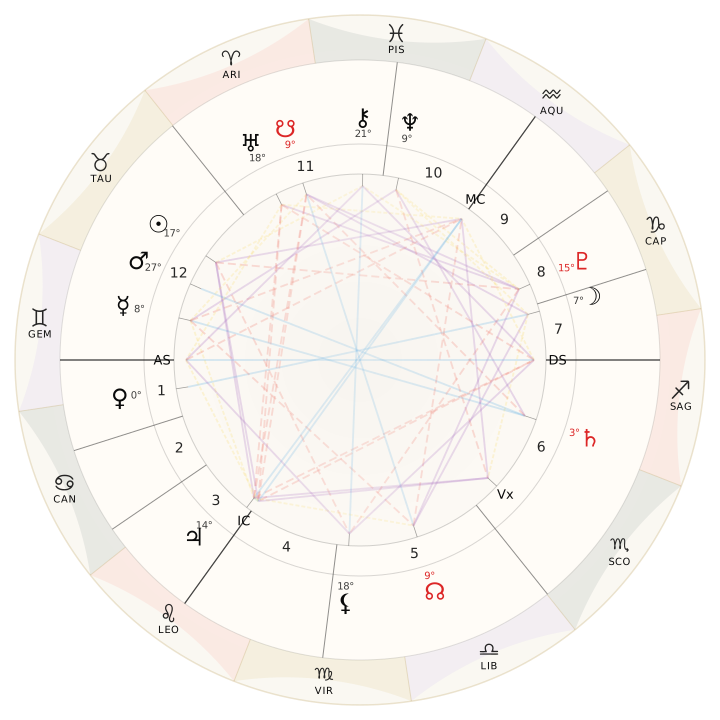
The sample preview above matches the natal wheel style you receive from this calculator. A natal wheel is a circular display of the zodiac and the house structure.
The zodiac is a 360-degree circle divided into twelve 30-degree sectors. A placement such as “Venus at 18° Gemini” comes from celestial longitude and is expressed as sign, degree within the sign, house under the chosen house system, and retrograde status when applicable. Aspect lines show angular relationships; tables let you verify those relationships without guessing from the drawing alone.
Calculation uses with Swiss Ephemeris data: local birth time is converted with timezone rules, positions are derived along the zodiac, and factors are assigned to houses. Interpretations remain symbolic traditions—not scientific claims about personality, health, money, or the future.
Reading the chart output
Start with a planet-in-sign list on the chart. Confirm your Sun matches what you expect from your birth date (edge births near changes still need time for the Moon and angles). Then find the Moon and Ascendant. Those three give a readable snapshot.
Next, scan houses with planets in them. Empty houses are not “broken”; they simply lack planetary residents, and their topics are still ruled by the placement on the cusp. Look for stelliums (multiple planets in one sector or house) and for the chart ruler connected to the Ascendant.
Aspect patterns—T-squares, grand trines, oppositions across the relationship axis—show dynamics. A tool that only dumps positions without any legend can feel opaque; one that overwhelms you with every minor asteroid on day one can feel noisy. Aim to learn the classical seven planets plus the outer planets before expanding.
Verify what the calculator shows
Be cautious with sites that market an online natal calculator but never show planetary positions. Narrative PDFs can be useful after you can verify the placements yourself. Verification is part of digital literacy in this field.
House systems without the headache
Whole Sign houses assign each house to an entire sign starting from the Ascendant. Equal houses start from the rising degree and carve thirty-degree slices. Quadrant systems such as Placidus vary house sizes by latitude and time. At high latitudes, some quadrant systems produce extreme house sizes—an astronomy fact, not a personal flaw.
Beginners can stay on one system for six months. Switching every week makes learning house topics impossible. Your tool should state the system; this form uses Placidus by default so your first map has a clear baseline.
Connecting this tool to specialized calculators
Sometimes you only need one symbol. What’s my rising sign isolates the Ascendant question. What’s my moon sign isolates the Moon. A free astrology chart emphasizes beginner free-access language for the same natal map. A south node calculator targets the nodal axis for karmic or developmental framing.
Use specialists for focus; return here when you need full context—because a Moon square Saturn means something different in the tenth house than in the fourth.
Data quality checklist before you calculate
Confirm the calendar date (including year). Prefer certificate times over rounded guesses. Select place suggestions rather than free-typing without coordinates. Note if you were born during a timezone law change. If twin births are involved, use each child’s own time.
When the map loads, spot-check: Does the Sun match a reliable reference for your date? Does the Ascendant change if you nudge the time by an hour in a test? Sensitivity tests teach you which statements are fragile.
Interpretation ethics
Online natal tools can surface intense topics: loss, conflict, desire, ambition. Read slowly. Avoid messaging strangers unsolicited judgments. Avoid using symbols to pressure partners or employees. If study increases anxiety, pause and seek grounded support.
Astrology here is educational and symbolic. It is not a medical device, legal advisor, or investment algorithm.
Why calculate online
A browser tool gives access without installing software, works on phones, and makes timezone handling less error-prone than paper tables. Keep the form visible, learn how the math works, then read the map with patience and correct birth data—looking beyond a single label.
Run the calculator
Enter your birth details above when ready. Submit to submit for chart computation and display—houses, angles, and ephemeris-based calculator positions included.